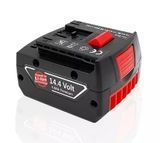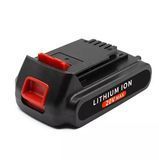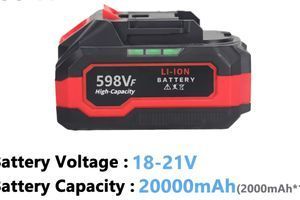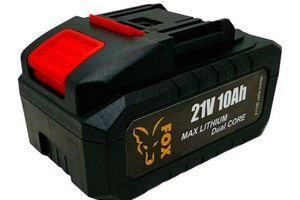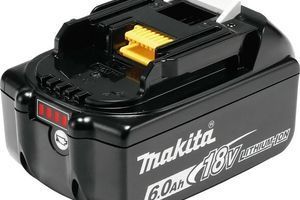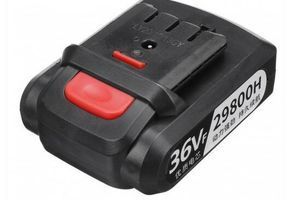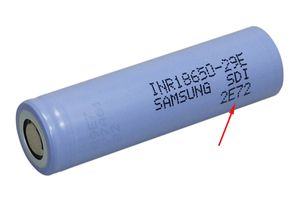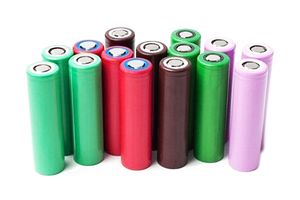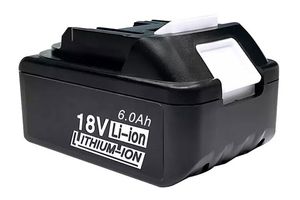
Capacity is one of the most important parameters of a power tool battery. Many users see the marking “5.0 Ah”, “6.0 Ah” or “10 Ah” on the battery, but do not always understand what exactly it means and how to check the real capacity. In this article, we will thoroughly examine what battery capacity is, how to measure it correctly, and what it gives in practice. Special attention will be paid to 18–21 V batteries — the most popular in the professional and household power tool segment (Makita LXT, DeWalt 20V MAX, Milwaukee M18, Bosch Professional, Metabo, Ryobi, etc.).
What Battery Capacity Means
Battery capacity is measured in ampere-hours (Ah) or milliampere-hours (mAh).
- Ah is the amount of electricity the battery can deliver in one hour at a certain current.
- Example: a 5.0 Ah battery can theoretically deliver 5 amps for 1 hour or 1 amp for 5 hours.
Capacity is the “size of the fuel tank” of the battery. The higher the Ah, the longer the tool runs on a single charge.
It is important to distinguish:
- Capacity (Ah) — how much electricity can be obtained.
- Energy (Wh — watt-hours) — the actual amount of energy = Capacity (Ah) × Nominal voltage (V).
For 18 V batteries:
- 5.0 Ah × 18 V = 90 Wh
- 6.0 Ah × 18 V = 108 Wh
- 8.0 Ah × 18 V = 144 Wh
For 20V MAX (actually the same 18 V nominal), the calculation is the same.
Nominal and Real Capacity
Manufacturers specify nominal capacity — the value measured under ideal conditions (temperature +20–25°C, low discharge current C/5–C/10, new battery).
Real capacity is almost always lower:
- At high discharge current (powerful tool) capacity decreases due to the Peukert effect.
- At low temperatures (<0°C) capacity can drop by 20–40%.
- After 300–500 cycles, capacity is usually 70–85% of nominal.
How to Determine the Capacity of an 18–21 V Battery
1. The simplest way — check the marking
The nominal capacity is always indicated on the battery body: 2.0 Ah, 3.0 Ah, 4.0 Ah, 5.0 Ah, 6.0 Ah, 8.0 Ah, 10.0 Ah, 12.0 Ah, etc.
2. Smart chargers
Modern original chargers (Makita DC18RC, DeWalt DCB115/DC B118, Milwaukee M18 Rapid Charger, etc.) during charging show:
- Current current
- Voltage
- Estimated remaining capacity (in %)
- Sometimes — calculated capacity in Ah
3. Constant load discharge test (most accurate home method)
You will need:
- Fully charged battery
- Constant load (car lamp 55–100 W, powerful resistor, electronic load or the tool itself)
- Multimeter or USB tester with current and time measurement
- Timer
Process:
- Connect the load through an ammeter.
- Record the initial voltage.
- Discharge until the tool shuts off or down to 15–16 V (do not go lower).
- Capacity (Ah) ≈ Average current (A) × Discharge time (hours).
4. Specialized capacity testers
- SkyRC MC3000, Opus BT-C3100, LiitoKala Lii-500 (with power tool adapter)
- Professional analyzers: Cadex C4000, Hioki BT3562, iCharger
- For 18–21 V, adapters with Makita/DeWalt/Milwaukee connectors are popular
5. Brand applications (Bluetooth batteries)
- Makita (Bluetooth batteries 4.0 Ah, 5.0 Ah, 6.0 Ah) — Makita Battery Monitor app shows exact capacity, temperature, cycle count and health status.
- DeWalt — Tool Connect app for some models.
- Milwaukee — One-Key system shows battery status.
Typical Capacities of 18–21 V Batteries by Popular Brands
Makita LXT 18V:
- 1.5 Ah, 3.0 Ah, 4.0 Ah, 5.0 Ah, 6.0 Ah (BL1860B is very popular)
DeWalt 20V MAX:
- 1.5 Ah, 2.0 Ah, 3.0 Ah, 4.0 Ah, 5.0 Ah, 6.0 Ah, 8.0 Ah, 10.0 Ah, 12.0 Ah (FlexVolt — switchable 20V/60V)
Milwaukee M18:
- 2.0 Ah, 4.0 Ah, 5.0 Ah, 6.0 Ah, 8.0 Ah, 12.0 Ah (High Output)
Bosch Professional 18V:
- 2.0 Ah, 3.0 Ah, 4.0 Ah, 5.0 Ah, 6.0 Ah, 8.0 Ah, 12.0 Ah (ProCore)
Factors Affecting Measured Capacity
- Temperature — optimal 15–30°C
- Discharge rate — the higher the current, the lower the delivered capacity
- Battery age — after 3–4 years capacity often drops to 70–80%
- Number of cycles — average resource of quality batteries 500–1500 full cycles
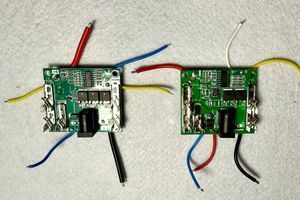
- BMS condition (protection board) — faulty balancer reduces available capacity
How to Interpret Capacity in Practice
- 1.5–2.0 Ah — lightweight batteries for small jobs (3–15 minutes under load)
- 3.0–4.0 Ah — universal option
- 5.0–6.0 Ah — optimal for most tasks (20–50 minutes of continuous work)
- 8.0–12.0 Ah — heavy batteries for long work (saws, grinders, rotary hammers)
Conclusion
Battery capacity (Ah) shows how much “fuel” the battery stores. For 18–21 V tools, real capacity is almost always lower than nominal and depends on operating conditions. The most accurate measurement methods are constant-load discharge or using branded Bluetooth batteries with the app. Regular capacity checks help detect degradation in time and plan battery replacement.